MazBook.ru
English Русский
Български
Беларускі
Український
Српски
Hrvatski
Română
Polski
Slovenský
Magyar
• Bookmark • Sitemap • Contacts •   
Cars Opel Cars Ford Cars Volkswagen Cars Audi Cars Kia Cars Renault Cars Peugeot


Familia Capella Mazda3 Mazda6 CX-? Others Articles
Capella 3 (1982-1992, petrol) Capella 3 and 4 (1982-1992) Capella 4 (1987-1992) Capella 5 (1991-1997) Capella 6 (1997-2005, petrol)

Camshafts and tappets — removal and installation (Mazda Capella GF)

  • Home
  • Mazda Capella
  • Capella GF (1997-2005)
  • Power unit
  • 6-cylinder engines
  • Camshafts and tappets — removal and installation
0
Contents: Removal ⇓ Inspection ⇓ Installation ⇓

Removal


1. Remove the cylinder head covers (see paragraph 4), toothed belt and camshaft sprockets (paragraph 6). If you plan to remove the front camshafts, then on 1997 and earlier models, also remove the ignition distributor (see chapter 5). To work with the rear block shafts, remove the intake manifold (see paragraph 8).

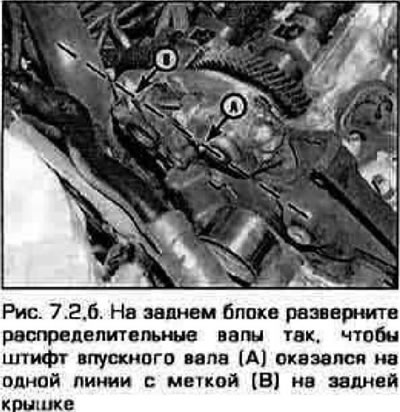
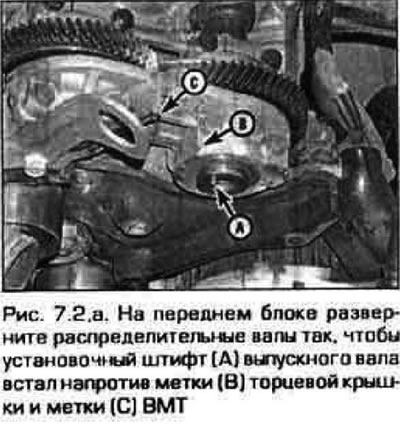
2. When removing the camshafts, care must be taken. The support cap bolts must be loosened strictly in the specified sequence. Otherwise, the pressure of the riveted springs will be unbalanced along the length of the shaft and the shaft may become warped and damage the supports. In this case, the cylinder head will have to be replaced. To equalize the spring pressure on the cams, rotate the shafts as shown in the figure 7.2,a,b.
2. When removing the camshafts, care must be taken. The support cap bolts must be loosened strictly…

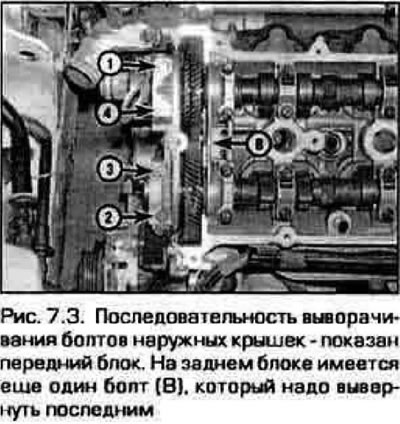
3. Gradually loosen the outer cover mounting bolts one by one, no more than 1/4 turn at a time in sequence. indicated in the figure 7.3.


3. Gradually loosen the outer cover mounting bolts one by one, no more than 1/4 turn at a time in…


4. Remove the seal and cover plug from the front end of the driven shaft.

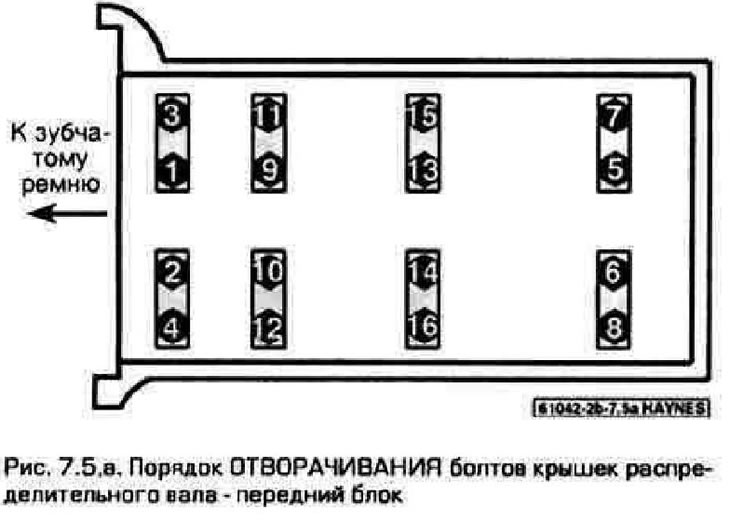
5. Loosen the cover bolts in the sequence shown in the figure 7.5.a,b, 1/4 turn at a time, until it becomes possible to turn them out by hand.
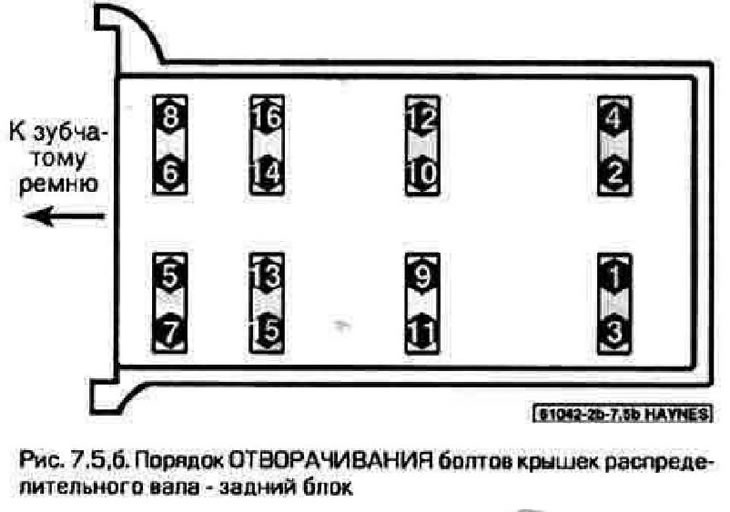
5. Loosen the cover bolts in the sequence shown in the figure 7.5.a,b, 1/4 turn at a time, until it…


5. Loosen the cover bolts in the sequence shown in the figure 7.5.a,b, 1/4 turn at a time, until it…


6. Remove the covers and carefully pull the shafts out of the supports. Keep the shafts horizontal.


7. Repeat this operation on the remaining block.

8. Store lids in the order they were installed. The front block covers have letter markings, and the rear block covers have digital markings (figure 7.8,a). If necessary, remove the pushers using a magnet (with gaskets on engines produced since 1999) (figure 7.8,b). Also store the tappets with gaskets in the order they were installed so that when reassembling they will take their original place. Hydraulic tappets (models produced before 1997) store upside down in an oil bath.
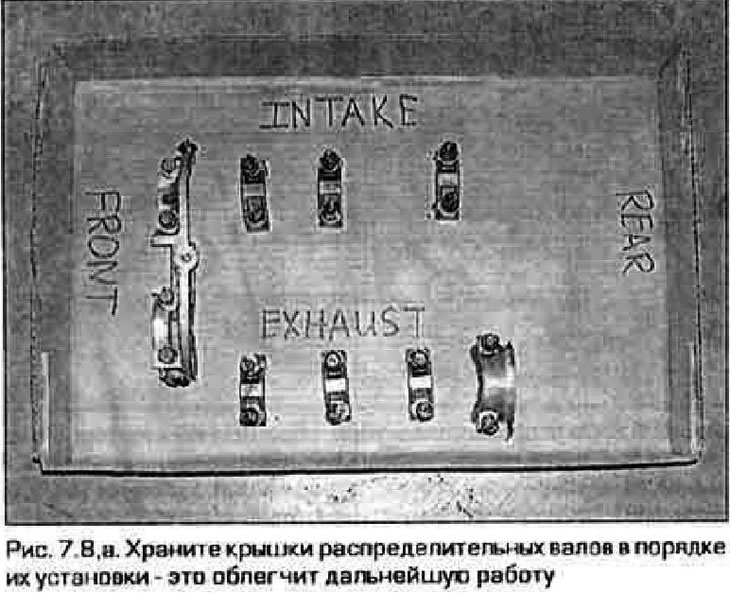
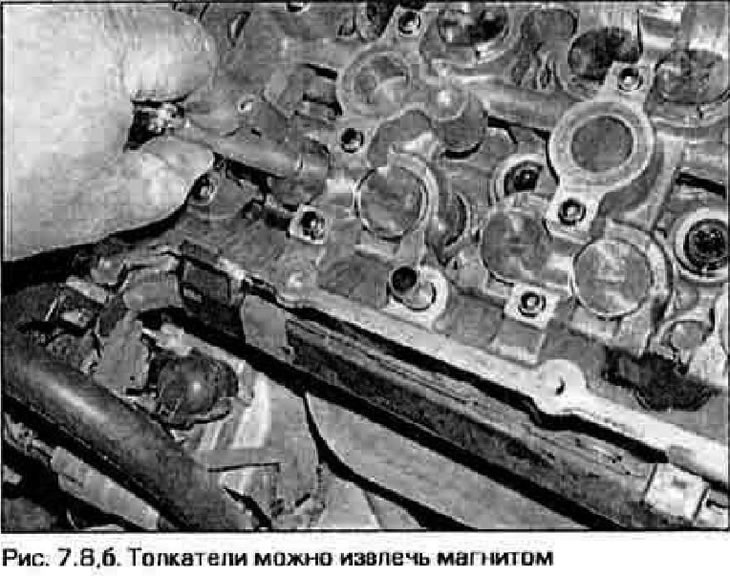
8. Store lids in the order they were installed. The front block covers have letter markings, and…


8. Store lids in the order they were installed. The front block covers have letter markings, and…


Inspection


9. Inspect the camshafts, lifters and associated components as specified in chapter 2B. Technical data for camshafts and tappets are also given in chapter 2B.

Installation


10. Lubricate the tappets with molybdenum-based grease and insert them into the bores in their original locations. If there were adjusting shims on the tappets, insert them back into their original positions as well.


11. Lubricate the camshaft cams and journals, as well as the thrust surfaces of their gears, with molybdenum grease.

12. Place the camshafts in the supports and engage their gears so that the timing marks on the inner sides of the gears align (figure 7.12).
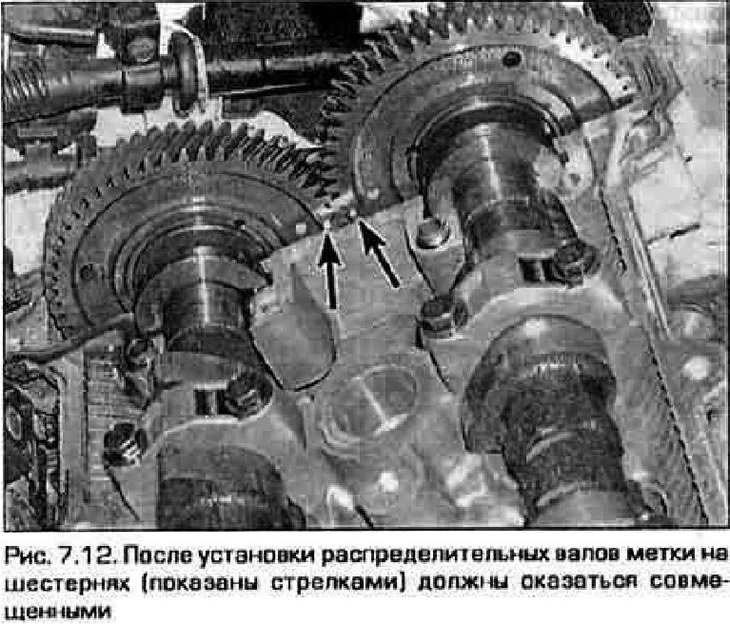
12. Place the camshafts in the supports and engage their gears so that the timing marks on the…


13. Apply a thin layer of RTV sealant to the outer edges of the cylinder head surfaces under the outer (thrust) camshaft bearing caps. Be careful not to let the sealant get on the shaft journals.

14. Check the shaft rotation (see Fig. 7.2, a, b). Install the thrust flanges onto the caps behind the shaft gears. Tighten the bolts only until the cover is seated in place.

15. Install the remaining covers back in place.

Note: The front block shaft covers are marked with letters, while the rear block shaft covers are marked with numbers.


16. Tighten the cover bolts in five or six passes (1/4 turn at a time) until the required force is achieved. Tighten the bolts in the recommended sequence (figure 7.16, a, b).
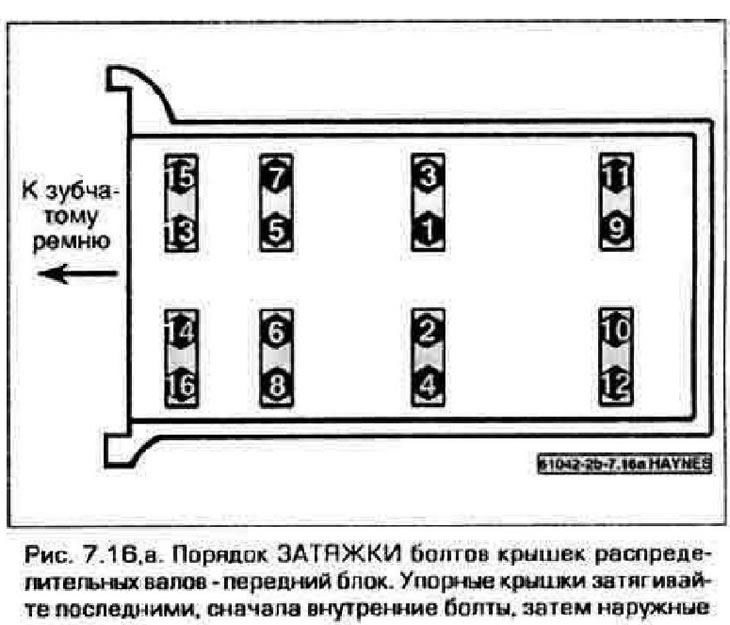
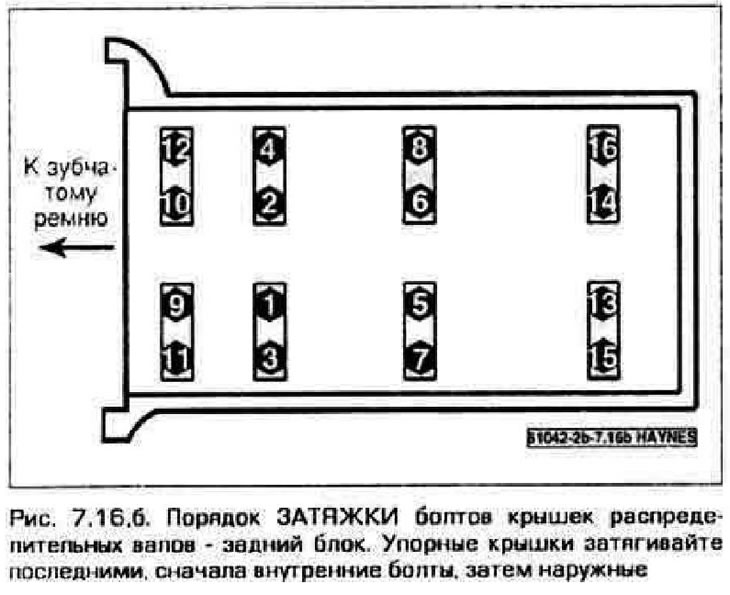
16. Tighten the cover bolts in five or six passes (1/4 turn at a time) until the required force is…


16. Tighten the cover bolts in five or six passes (1/4 turn at a time) until the required force is…


17. Wet the working edge of the shaft seal with clean engine oil. Insert the cuff into the socket and press it through a mandrel slightly smaller than the outer diameter of the cuff (figure 7.17). After pressing, the cuff should protrude from the socket by approximately 5 mm.
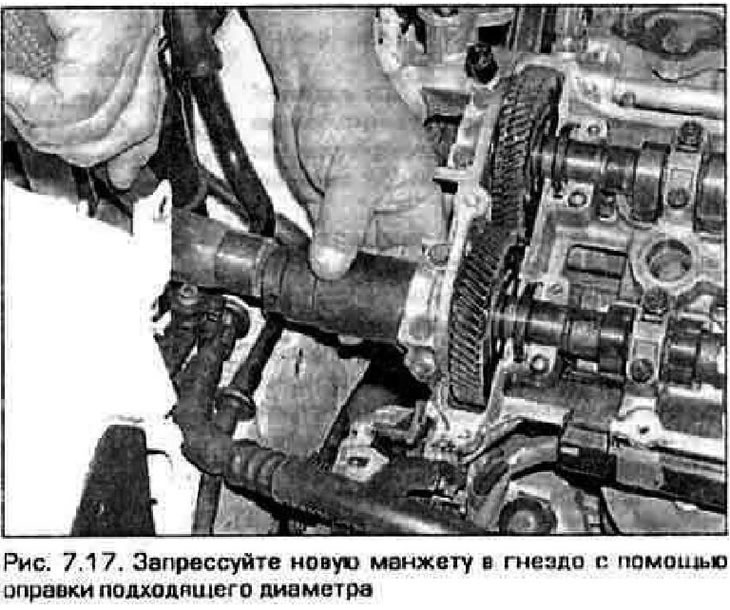


17. Wet the working edge of the shaft seal with clean engine oil. Insert the cuff into the socket…


18. Insert plugs into the ends of the outer supports of the driven shafts. Before installing the plugs, apply RTV sealant to them. Press the plugs flush with the supports using a mallet.

19. Install the remaining parts in the reverse order of removal.

20. On models produced since 1998, check and, if necessary, adjust the valve clearances.

21. Start the engine and check its operation.
This article is available at: russian, bulgarian, belarusian, ukrainian, serbian, croatian, romanian, polish, slovak, hungarian
This text was checked by: German Vorobyov
Share with friends on social networks:

Previous
Capella 6 » 6-cylinder engines
Next

Timing Belt and Sprockets — removal, inspection, and installation
Valve springs and valve stem seals — replacement
Cylinder Head Covers — removal and installation
Setting piston No. 1 to top dead center (TDC)
Repair operations performed without removing the engine
Intake manifold — removal and installation
Exhaust manifolds — removal and installation
Cylinder heads — removal and installation
Front Crankshaft Oil Seal — replacement
Oil pan — removal and installation
More articles on repairing other Mazda models
Removal and installation camshafts (BP DOHC engines) Mazda Familia 6 (1989-1994)
Installing camshafts Mazda3 BK (2003-2009)
Checking camshafts Mazda CX-5KE (2012-2017)
Removal and installation camshafts Mazda 121 (3) (1996-2003)
Link in different formats to this article
Comments and feedback from visitors
No comments yet


How much will 29 + 36 ?


Capella 6 (1997-2005, petrol) 
  • General information
  • Introduction to guide
  • User manual
  • Troubleshooting
  • Maintenance
  • Power unit
  • 4-cylinder engines
  • 6-cylinder engines
  • Engine overhaul
  • Cooling and ventilation
  • Power and exhaust systems
  • Engine electrics
  • Control system
  • Transmission
  • Mechanical gearbox
  • Automatic gearbox
  • Clutch and drive shafts
  • Chassis
  • Brake system
  • Car suspension
  • Steering
  • Body
  • Exterior (external elements)
  • Interior (internal elements)
  • Doors, windows and locks
  • Electrical equipment
  • Equipment and devices
  • Electrical circuits
Capella 5 (1991-1997) 
  • General information
  • User manual
  • Maintenance
  • Helpful hints
  • Power unit
  • Petrol engines 1.6 and 1.8
  • Petrol engines 2.0
  • 2.5 petrol engines
  • Overhaul engines 1.6 and 1.8
  • Overhaul engines 2.0 and 2.5
  • Diesel engine 2.0
  • Engine electrics
  • Cooling system
  • Air conditioner
  • Carburetor Nikki 30/34
  • Power system (1.6 and 1.8)
  • Power system (2.0 and 2.5)
  • Control system
  • Transmission
  • Mechanical gearbox
  • Automatic gearbox
  • Clutch and axles
  • Chassis
  • Brake system
  • Suspension and wheels
  • Steering
  • Body
  • Exterior (external elements)
  • Interior (internal elements)
  • Doors and windows
  • Electrical equipment
  • Equipment and devices
  • Electrical circuits
Capella 4 (1987-1992) 
  • General information
  • Introduction to manual
  • Vehicle specifications
  • Power unit
  • Engine repair
  • Lubrication system
  • Cooling system
  • Fuel system (carburetor)
  • Fuel injection (FE)
  • Fuel injection (DOHC)
  • Fuel system (diesel)
  • Ignition system
  • Transmission
  • Clutch
  • Gearbox
  • Drive shafts
  • Chassis
  • Front suspension
  • Rear suspension
  • Steering system
  • Brake system
  • Electrical equipment
  • Equipment and devices
  • Electrical circuits
Capella 3 and 4 (1982-1992) 
  • General information
  • User manual
  • Maintenance
  • Power unit
  • Gasoline engine
  • Engine overhaul (gasoline)
  • Diesel engine
  • Cooling and heating
  • Supply system
  • Ignition system
  • Emission reduction
  • Transmission
  • Clutch
  • Mechanical gearbox
  • Automatic gearbox
  • Drive shafts
  • Chassis
  • Brake system
  • Suspension and wheels
  • Steering
  • Body
  • Exterior (external elements)
  • Interior (internal elements)
  • Electrical equipment
  • Equipment and devices
  • Power devices
  • Electrical circuits
Capella 3 (1982-1992, petrol) 
  • General information
  • User manual
  • Maintenance
  • Troubleshooting
  • Late models
  • Power unit
  • Engine in car
  • Engine overhaul
  • Cooling and heating system
  • Fuel and exhaust system
  • Engine electrical system
  • Emission control system
  • Transmission
  • Mechanical gearbox
  • Automatic gearbox
  • Clutch and drive shafts
  • Chassis
  • Brake system
  • Suspension and wheels
  • Steering
  • Body
  • Exterior (external elements)
  • Interior (internal elements)
  • Electrical equipment
  • Equipment and devices
  • Lighting and lamps
  • Electrical circuits
MazBook.ru © 2018–2026 · Mobile version · Articles and news · Sitemap: EN BG BY UA RS HR RO PL SK HU · Feedback · Site search · Add to bookmarks Familia 5 (BF) · Familia 6 (BG) · Capella 3 (GC) · Capella 3 and 4 (GC) · Capella 4 (GD) · Capella 5 (GE) · Capella 6 (GF) · Mazda3 BK · Mazda6 GG · CX-5KE · Mazda 121 (3) · Mazda BT-50 (1) ·
By continuing to use the site, you agree to the use of cookies 🔐