
MazBook.ru
English Русский
Български
Беларускі
Український
Српски
Hrvatski
Română
Polski
Slovenský
Magyar
• Bookmark • Sitemap • Contacts •   
Cars Opel Cars Ford Cars Volkswagen Cars Audi Cars Kia Cars Renault Cars Peugeot


Familia Capella Mazda3 Mazda6 CX-? Others Articles
Capella 3 (1982-1992, petrol) Capella 3 and 4 (1982-1992) Capella 4 (1987-1992) Capella 5 (1991-1997) Capella 6 (1997-2005, petrol)

Valve springs and valve stem seals — replacement (Mazda Capella GF)

  • Home
  • Mazda Capella
  • Capella GF (1997-2005)
  • Power unit
  • 6-cylinder engines
  • Valve springs and valve stem seals — replacement
0
Note 1: Broken valve springs and valve stem seals can be replaced without removing the cylinder head from the engine. This operation will require several special tools and a source of compressed air, so please read the entire paragraph to assess your ability to handle this job.


Note 2. On engines produced since 1998, before starting the operation, check the valve clearances (see chapter 1), since clearance adjustment can be combined with this procedure.


1. Remove the camshaft (see paragraph 7). Remove the tappets from the faulty valve drive. Store the tappets in the order they were installed in the engine. When assembled, they should be pressed back into their previous position.

2. Remove the spark plug from the cylinder with the faulty valve. If you plan to replace all valve caps, remove all spark plugs.

3. Rotate the crankshaft until the corresponding piston is at TDC in the compression stroke (see paragraph 3). If all valve stem seals need to be replaced, start with cylinder #1 and proceed to the next cylinders in turn in accordance with the cylinder firing order (see Technical data at the beginning of this chapter).

4. Screw a long adapter into the spark plug hole, and connect a hose from a compressed air source to the other end (figure 5.4) (compressed air in the cylinder will hold the valves in the up position until the spring is removed from them).
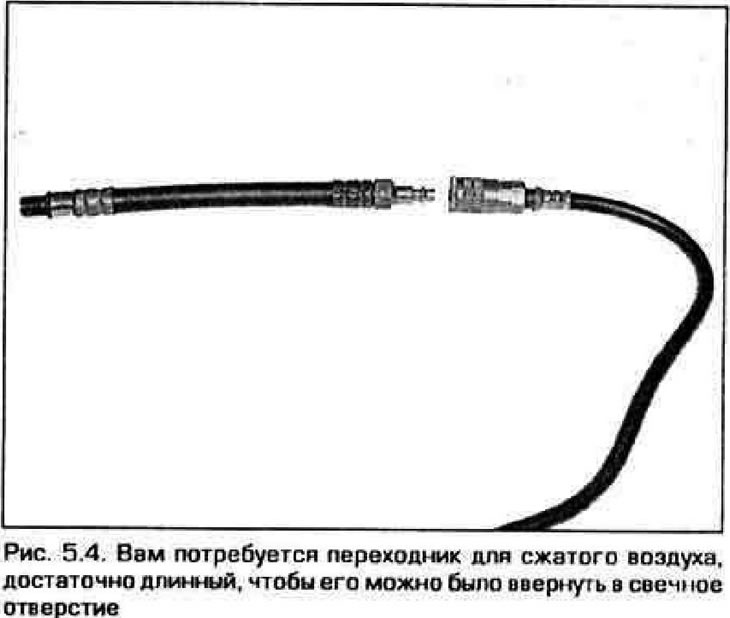
4. Screw a long adapter into the spark plug hole, and connect a hose from a compressed air source…


5. Supply compressed air to the cylinder. Be careful: under the action of compressed air, the piston can go down and suddenly turn the crankshaft. If the wrench you used to turn the crankshaft is still on the crankshaft end bolt, it could cause injury or significant damage to the vehicle when turning the crankshaft.


6. The valves should now be held closed using compressed air.

7. Fill all the holes in the cylinder head around the valves with clean rags to prevent any foreign objects from falling into the cylinder. Using a tool, compress the valve spring and remove the crackers from the upper spring plate (figure 5.7).

Note: To compress the springs, you will need a special device that can be secured in the desired location without removing the cylinder head.
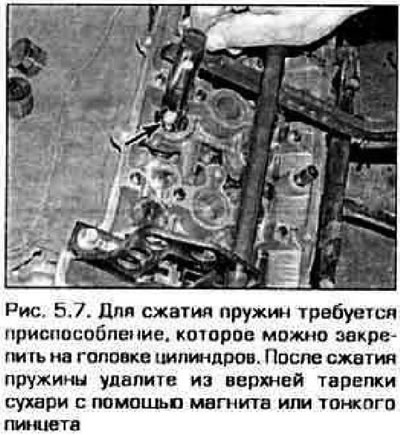

Note: To compress the springs, you will need a special device that can be secured in the desired…


8. Remove the upper plate, spring and spring support washer. Note the depth of the cap in the head and pull out the cap (figure 5.8). Label the parts or store them so that the set of parts is in the same place when reassembled.
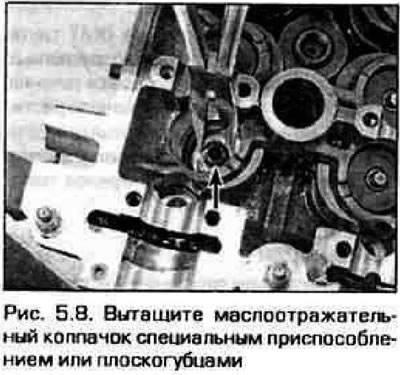
8. Remove the upper plate, spring and spring support washer. Note the depth of the cap in the head…


Note: If the compressed air does not hold the valve closed during this operation, the valve itself or its seat may be damaged. In this case, the cylinder head will have to be removed.


9. Inspect the valve spring for cracks or other damage. Measure the length of the spring in its free state and compare it with the value specified in Technical data of chapter 2B.

10. Lubricate the valve stem with engine oil and insert the new valve stem seal into its seat. Recess the cap to its original depth using a special adapter or a long socket wrench (figure 5.10).
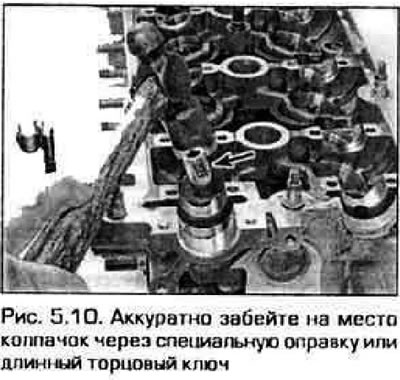
10. Lubricate the valve stem with engine oil and insert the new valve stem seal into its seat.…


11. Insert the thrust washer and spring (figure 5.12). Install the spring with the coils close together towards the cylinder head.

12. Install the upper valve plate. Compress the spring and carefully insert the crackers into the valve stem groove. To prevent the crackers from falling out during installation, apply a small amount of grease to them (figure 5.12).
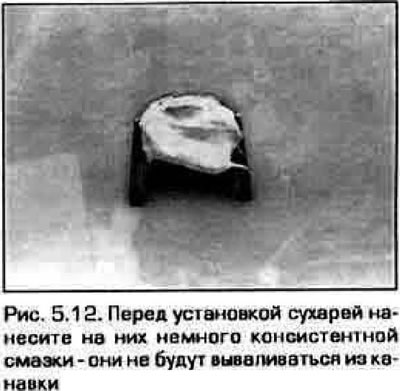
12. Install the upper valve plate. Compress the spring and carefully insert the crackers into the…


13. Slowly release the spring compressor, ensuring that the crackers are securely in place.


14. Turn off the compressed air, disconnect the hose and unscrew the adapter from the spark plug hole,

15. Insert the tappets and install the camshaft (see paragraph 7).

16. Install the remaining parts in the reverse order of removal.

17. Start the engine, check for leaks and unusual noises from the valves.

Note: On pre-1998 models, the hydraulic lifters may make noise initially. This noise should gradually disappear as the lifters fill with oil.
This article is available at: russian, bulgarian, belarusian, ukrainian, serbian, croatian, romanian, polish, slovak, hungarian
This text was checked by: German Vorobyov
Share with friends on social networks:

Previous
Capella 6 » 6-cylinder engines
Next

Cylinder Head Covers — removal and installation
Setting piston No. 1 to top dead center (TDC)
Repair operations performed without removing the engine
General information about repairing a six-cylinder engine
Technical data of the six-cylinder engine
Timing Belt and Sprockets — removal, inspection, and installation
Camshafts and tappets — removal and installation
Intake manifold — removal and installation
Exhaust manifolds — removal and installation
Cylinder heads — removal and installation
More articles on repairing other Mazda models
Replacing the valve stem seals Mazda Familia 6 (1989-1994)
Valve, valve spring, valve stem seal, valve guide Mazda3 BK (2003-2009)
Valve, valve spring, valve stem seal, valve guide Mazda6 GG (2002-2008)
Checking valve springs Mazda CX-5KE (2012-2017)
Replacing valve stem seals Mazda 121 (3) (1996-2003)
Link in different formats to this article
Comments and feedback from visitors
No comments yet


How much will 25 + 43 ?


Capella 6 (1997-2005, petrol) 
  • General information
  • Introduction to guide
  • User manual
  • Troubleshooting
  • Maintenance
  • Power unit
  • 4-cylinder engines
  • 6-cylinder engines
  • Engine overhaul
  • Cooling and ventilation
  • Power and exhaust systems
  • Engine electrics
  • Control system
  • Transmission
  • Mechanical gearbox
  • Automatic gearbox
  • Clutch and drive shafts
  • Chassis
  • Brake system
  • Car suspension
  • Steering
  • Body
  • Exterior (external elements)
  • Interior (internal elements)
  • Doors, windows and locks
  • Electrical equipment
  • Equipment and devices
  • Electrical circuits
Capella 5 (1991-1997) 
  • General information
  • User manual
  • Maintenance
  • Helpful hints
  • Power unit
  • Petrol engines 1.6 and 1.8
  • Petrol engines 2.0
  • 2.5 petrol engines
  • Overhaul engines 1.6 and 1.8
  • Overhaul engines 2.0 and 2.5
  • Diesel engine 2.0
  • Engine electrics
  • Cooling system
  • Air conditioner
  • Carburetor Nikki 30/34
  • Power system (1.6 and 1.8)
  • Power system (2.0 and 2.5)
  • Control system
  • Transmission
  • Mechanical gearbox
  • Automatic gearbox
  • Clutch and axles
  • Chassis
  • Brake system
  • Suspension and wheels
  • Steering
  • Body
  • Exterior (external elements)
  • Interior (internal elements)
  • Doors and windows
  • Electrical equipment
  • Equipment and devices
  • Electrical circuits
Capella 4 (1987-1992) 
  • General information
  • Introduction to manual
  • Vehicle specifications
  • Power unit
  • Engine repair
  • Lubrication system
  • Cooling system
  • Fuel system (carburetor)
  • Fuel injection (FE)
  • Fuel injection (DOHC)
  • Fuel system (diesel)
  • Ignition system
  • Transmission
  • Clutch
  • Gearbox
  • Drive shafts
  • Chassis
  • Front suspension
  • Rear suspension
  • Steering system
  • Brake system
  • Electrical equipment
  • Equipment and devices
  • Electrical circuits
Capella 3 and 4 (1982-1992) 
  • General information
  • User manual
  • Maintenance
  • Power unit
  • Gasoline engine
  • Engine overhaul (gasoline)
  • Diesel engine
  • Cooling and heating
  • Supply system
  • Ignition system
  • Emission reduction
  • Transmission
  • Clutch
  • Mechanical gearbox
  • Automatic gearbox
  • Drive shafts
  • Chassis
  • Brake system
  • Suspension and wheels
  • Steering
  • Body
  • Exterior (external elements)
  • Interior (internal elements)
  • Electrical equipment
  • Equipment and devices
  • Power devices
  • Electrical circuits
Capella 3 (1982-1992, petrol) 
  • General information
  • User manual
  • Maintenance
  • Troubleshooting
  • Late models
  • Power unit
  • Engine in car
  • Engine overhaul
  • Cooling and heating system
  • Fuel and exhaust system
  • Engine electrical system
  • Emission control system
  • Transmission
  • Mechanical gearbox
  • Automatic gearbox
  • Clutch and drive shafts
  • Chassis
  • Brake system
  • Suspension and wheels
  • Steering
  • Body
  • Exterior (external elements)
  • Interior (internal elements)
  • Electrical equipment
  • Equipment and devices
  • Lighting and lamps
  • Electrical circuits
MazBook.ru © 2018–2026 · Mobile version · Articles and news · Sitemap: EN BG BY UA RS HR RO PL SK HU · Feedback · Site search · Add to bookmarks Familia 5 (BF) · Familia 6 (BG) · Capella 3 (GC) · Capella 3 and 4 (GC) · Capella 4 (GD) · Capella 5 (GE) · Capella 6 (GF) · Mazda3 BK · Mazda6 GG · CX-5KE · Mazda 121 (3) · Mazda BT-50 (1) ·
By continuing to use the site, you agree to the use of cookies 🔐