


Contents: Removal ⇓ Installation ⇓
Removal
1. Disconnect the negative cable from the battery.
Caution: If your vehicle has a theft-protected audio system, make sure you have the unlock code for it before disconnecting the battery.
2. Drain the coolant, including from the block (see chapter 1). Disconnect the upper radiator hose from the engine side.
3. Remove the air ducts and air cleaner. Remove the intake manifold (see paragraph 8).
[Content based on information from MazBook]
4. Remove the exhaust manifolds (see paragraph 9).
5. Remove the generator. Disconnect and remove the high-voltage wires, distributor and ignition coil (or a coil pack on later models) (see chapter 5).
6. Remove the timing belt, camshaft sprockets, guide rollers and tension rollers (see paragraph 6).
7. Remove the camshafts and tappets (see paragraph 7).
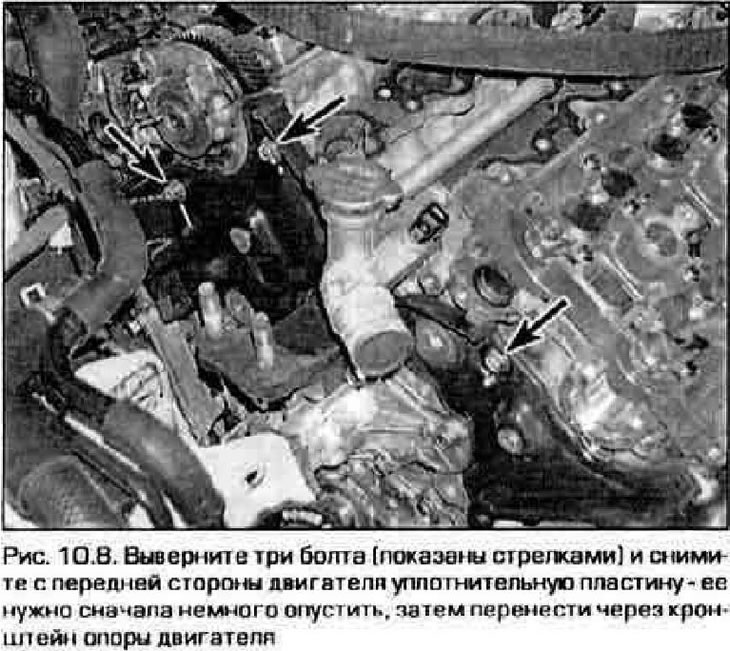
8. Remove the bolts and sealing plate from the front of the engine (figure 10.8).
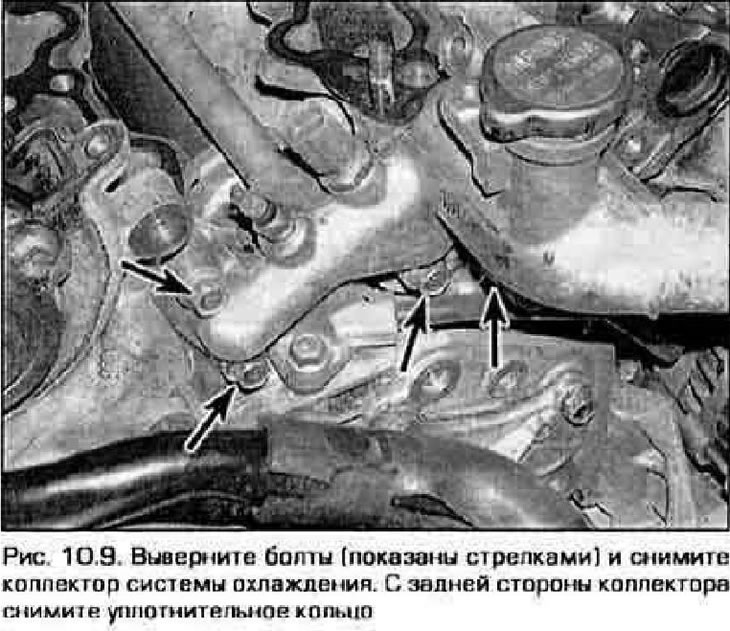
9. Remove the cooling system outlet manifold from the cylinder heads (figure 10.9).
10. Release the wire harnesses from the rear of the heads and move them to the side.
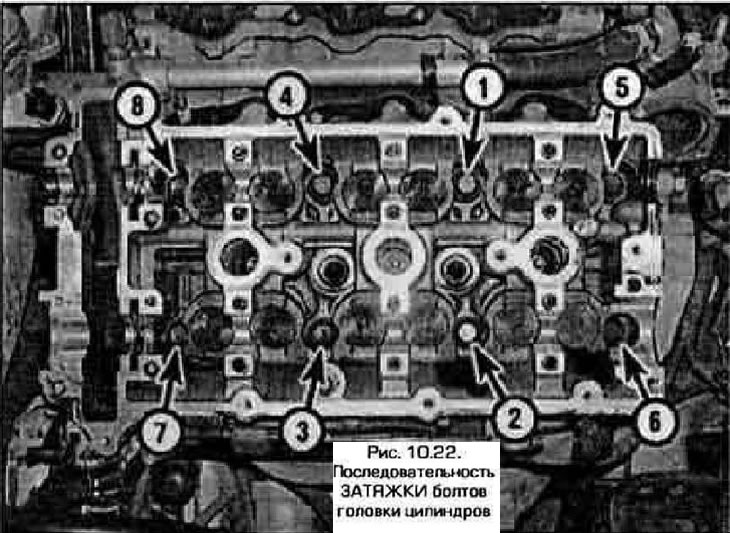
11. In the opposite order to that. what is shown in the picture 10.22. Gradually loosen and remove the cylinder head mounting bolts no more than 1/4 turn at a time until they can be removed completely by hand. The bolts can be thrown away - they will have to be replaced, but the washers can be saved for recycling,
12. Lift the head from the block. If the head has dried on the gasket, tap it with a hammer through a wooden block. Don't be afraid to pry the head off the block by inserting a screwdriver or other similar tool between them. This will damage the surfaces and the joint will leak.
13. Remove the second head in the same way.
Installation
14. Before installing the heads, thoroughly clean the mating surfaces.
15. Scrape off any remaining old gasket and carbon deposits from the surfaces, then wash the surfaces with nitro solvent or acetone. If traces of oil remain on the surfaces, the gasket will not seal the joint reliably and leaks may occur. When cleaning the block surfaces, fill the cylinder bores with rags to prevent dirt from getting into the cylinders. After finishing the work, clean the cylinders with a vacuum cleaner to be on the safe side.
16. Inspect the mating surfaces of the head and block for scratches, dents and other damage. Any damage should be removed by machine treatment only - do not attempt to do this with a file or sandpaper.
17. Use a tap to tap the threaded holes for the head bolts, then blow out the holes with compressed air to remove any chips.
Caution! Wear safety glasses when working with compressed air.
18. It is recommended to replace all head mounting bolts with new ones. Washers can be reused.
19. Install a new gasket on the block.
Note: Each gasket is marked to indicate which side up it should be installed and whether it is intended for the front or rear block.
20. Carefully lower the head onto the block, being careful not to move the gasket.
21. Before screwing in the bolts, lubricate their threaded parts with clean engine oil.
22. Screw the bolts into all holes and tighten them only by hand at first. Then in the sequence shown in the figure 10.22, gradually tighten them until the torque specified in the Technical Data at the beginning of the chapter is reached (1st stage).
23. Make a paint mark on the front face of the bolt or on the thorium head that is used to tighten the bolts. Place the head on the bolt like this. until the mark is visible, and tighten the bolt an additional 1/4 turn (i.e., 90°, 2nd tightening stage). Tighten all bolts in the same manner in the specified sequence.
24. Go through all the bolts again and tighten them in the same sequence by another 90° (3rd stage of tightening).
25. Install the second head in the same way.
26. The rest of the installation is carried out in the reverse order of disassembly. When installing the cooling system manifold, replace its gasket and sealing ring. This must be done before installing the intake manifold.
27. Fill the cooling system, change the oil and oil filter. Start the engine and check for leaks.