


Technical data of the starter
| Minimum permissible brush length, mm | 11,5 |
| Gear clearance, mm#0,5-2,0 |
Checking the starter motor without removing it from the vehicle
If the starter motor does not turn when the key is turned in the ignition switch, on vehicles with an automatic transmission, make sure the selector lever is in the "park" or "neutral" position.
Make sure the battery is charged and check that the wires on the battery terminals and the starter solenoid are securely fastened.
If the starter motor does not rotate when you turn the key in the ignition switch, but you hear the traction relay clicking even though the battery is fully charged, then the relay contacts or the starter motor are faulty.
If you cannot hear the traction relay click when you turn the key in the ignition switch, this means that the traction relay is faulty or there is a break in the relay's electrical circuit.
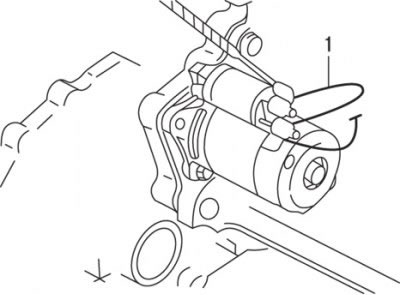
Figure 13.15. Using a jumper (1) to connect terminals "B" and "M" of the traction relay to check the operability of the starter motor
To check the electric motor, connect the terminals "B" and "M" on the traction relay with a jumper (figure 13.15). If the electric motor rotates, it is working properly, and the fault should be looked for in the traction relay, ignition switch or wires. It should be noted that in this test the electric motor will not rotate the crankshaft, since the traction relay, which engages the starter pinion with the flywheel ring gear, is excluded from the power supply circuit by a jumper.
If the electric motor does not turn, remove the starter assembly with the solenoid relay for disassembly, inspection, repair or replacement.