
MazBook.ru
English Русский
Български
Беларускі
Український
Српски
Hrvatski
Română
Polski
Slovenský
Magyar
• Bookmark • Sitemap • Contacts •   
Cars Opel Cars Ford Cars Volkswagen Cars Audi Cars Kia Cars Renault Cars Peugeot


Familia Capella Mazda3 Mazda6 CX-? Others Articles
Capella 3 (1982-1992, petrol) Capella 3 and 4 (1982-1992) Capella 4 (1987-1992) Capella 5 (1991-1997) Capella 6 (1997-2005, petrol)

Checking the power supply system (Mazda Capella GC)

  • Home
  • Mazda Capella
  • Capella GC (1982-1992)
  • General information
  • Maintenance
  • Checking the power supply system
0
Contents: Replacing the fuel filter ⇓ Checking and adjusting the…⇓ Checking the tightening torque of…⇓
Warning! Gasoline is extremely flammable. Therefore, when working with fuel system components, the use of open flames, sparking devices, open fire-hazardous lighting devices, and smoking are prohibited. Sparking should be avoided when working with wires and electrical devices.


Warning! Since gasoline is a carcinogen, avoid contact with your body or your vehicle's paintwork. Otherwise, you should immediately wash the area with soap and water.


The fuel supply system is constantly under pressure, so relieve the pressure in the fuel system before disconnecting the lines.

Immediately close all disconnected fuel lines to prevent fuel from leaking from the fuel tank.
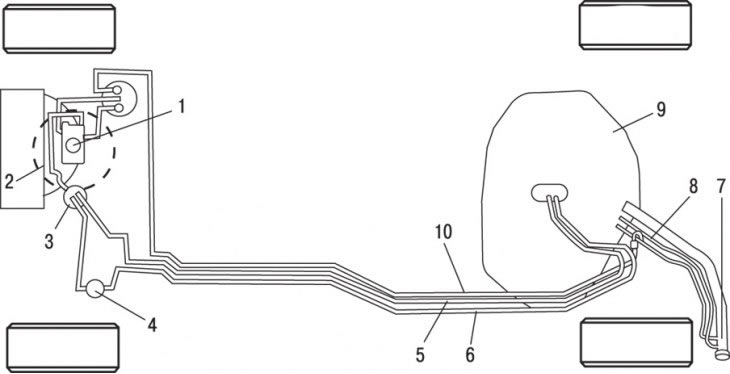
Figure 2.13. Location of the main elements of the fuel system on the vehicle: 1 – carburetor; 2 –…

Figure 2.13. Location of the main elements of the fuel system on the vehicle: 1 – carburetor; 2 – air filter; 3 – fuel pump; 4 – fuel filter; 5 – fuel return pipeline; 6 – fuel supply pipeline; 7 – filler neck; 8 – bypass valve; 9 – fuel tank; 10 – fuel vapor discharge pipeline


It is more convenient to service the fuel system on a vehicle raised on a lift, since all systems are clearly visible and accessible from underneath the vehicle (figure 2.13).


If you smell gasoline, inspect the fuel system immediately.

Open the filler cap and check it for damage or corrosion. The cover gasket must be elastic and not damaged, otherwise replace it.

Inspect the fuel supply and return hoses for cracks or damage. If there is any damage, replace them.

To inspect the fuel tank and the fuel lines connected to it, raise the vehicle on a lift. Pay special attention to the hose connecting the fuel tank and the filler neck.

Warning! Do not repair the fuel tank yourself under any circumstances. Using a welding torch or any open flame may cause fuel vapors accumulated in the tank to explode.


Replacing the fuel filter


The fuel system is sensitive to fuel contamination, so it passes through a special fuel filter. Dirt particles suspended in fuel can come from a freshly filled container at a filling station.

The fuel filter is located on the left side of the engine compartment. It is a consumable, disposable type of part and must be replaced in accordance with the specified intervals.

Place a rag or newspaper under the fuel filter to collect any fuel that leaks when disconnecting the hoses.

Mark the location of the fuel inlet and outlet hoses on the fuel filter, loosen the clamps and disconnect the hoses from the filter.

Mark the flow direction on the filter with an arrow and remove the filter from the mount.

Install the new filter, the arrow should point in the right direction, then connect the hoses and secure them with clamps.

Checking and adjusting the accelerator cable


Accelerator cable (throttle control) it must be checked and adjusted periodically to ensure its proper functioning.


Measure the total length of the cable to ensure it is sufficient for adjustment.

With the engine at normal operating temperature, make sure the carburetor choke is fully open.
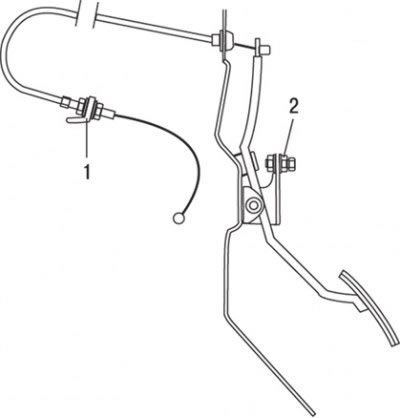
Figure 2.14. Accelerator cable adjustment elements: 1 – nut for adjusting the free play of the…

Figure 2.14. Accelerator cable adjustment elements: 1 – nut for adjusting the free play of the accelerator cable on the carburetor side; 2 – bolt for adjusting the position of the accelerator pedal for full opening of the throttle valve


Measure the free play of the cable on the carburetor side and adjust it if necessary. If the free play exceeds 3 mm, adjust it by turning nut 1 (figure 2.14) fastening the cable sheath to the bracket.

Checking the tightening torque of the carburetor mounting nuts


The carburetor is secured to the top of the intake manifold with four nuts. The nuts may become loose due to vibration and high temperatures, which may lead to a loss of seal and air leakage.

If you suspect that air is being sucked into the bottom of the carburetor, use a long hose with a diameter equal to the diameter of the fuel supply hose. Start the engine and place one end of the hose to your ear, and use the other end to inspect the area around the base of the carburetor. If there is an air leak, a hissing sound will be heard.


Remove the air filter housing and use tape to label each disconnected hose to make installation easier.

Determine what special tools or adapters are needed to tighten the carburetor mounting nuts. Manufacturers do not specify tightening torques for carburetor mounting nuts.

Tighten the nuts securely and evenly. Do not overtighten them as this may strip the threads.

If air continues to leak after tightening the nuts, the carburetor must be removed and a new gasket installed.

After tightening the carburetor mounting nuts, reinstall the air filter housing and connect all hoses.

[The text of the article is taken from the website: MazBook.ru]
This article is available at: russian, bulgarian, belarusian, ukrainian, serbian, croatian, romanian, polish, slovak, hungarian
This text was checked by: Georgy Afanasyev
Share with friends on social networks:

Previous
Capella 3 and 4 » Maintenance
Next

Changing the oil filter and engine oil
Checking and adjusting the engine idle speed and the quality of the…
Checking the position of the carburetor air damper
Checking the brake system
Checking the suspension and steering
Checking the engine intake air thermostat
Checking the seals and protective boots of the constant velocity…
Wheel rotation
Adjusting the clutch pedal travel
Changing the transmission fluid in a manual transmission
More articles on repairing other Mazda models
Technical characteristics of the power supply system Mazda Familia 5 (1985-1989)
Checking the level of working fluid in the power steering reservoir Mazda3 BK (2003-2009)
Checking the level of working fluid in the power steering reservoir Mazda6 GG (2002-2008)
Power supply system maintenance Mazda CX-5KE (2012-2017)
Checking the cooling system for tightness Mazda 121 (3) (1996-2003)
Link in different formats to this article
Comments and feedback from visitors
No comments yet


How much will 45 + 16 ?


Capella 6 (1997-2005, petrol) 
  • General information
  • Introduction to guide
  • User manual
  • Troubleshooting
  • Maintenance
  • Power unit
  • 4-cylinder engines
  • 6-cylinder engines
  • Engine overhaul
  • Cooling and ventilation
  • Power and exhaust systems
  • Engine electrics
  • Control system
  • Transmission
  • Mechanical gearbox
  • Automatic gearbox
  • Clutch and drive shafts
  • Chassis
  • Brake system
  • Car suspension
  • Steering
  • Body
  • Exterior (external elements)
  • Interior (internal elements)
  • Doors, windows and locks
  • Electrical equipment
  • Equipment and devices
  • Electrical circuits
Capella 5 (1991-1997) 
  • General information
  • User manual
  • Maintenance
  • Helpful hints
  • Power unit
  • Petrol engines 1.6 and 1.8
  • Petrol engines 2.0
  • 2.5 petrol engines
  • Overhaul engines 1.6 and 1.8
  • Overhaul engines 2.0 and 2.5
  • Diesel engine 2.0
  • Engine electrics
  • Cooling system
  • Air conditioner
  • Carburetor Nikki 30/34
  • Power system (1.6 and 1.8)
  • Power system (2.0 and 2.5)
  • Control system
  • Transmission
  • Mechanical gearbox
  • Automatic gearbox
  • Clutch and axles
  • Chassis
  • Brake system
  • Suspension and wheels
  • Steering
  • Body
  • Exterior (external elements)
  • Interior (internal elements)
  • Doors and windows
  • Electrical equipment
  • Equipment and devices
  • Electrical circuits
Capella 4 (1987-1992) 
  • General information
  • Introduction to manual
  • Vehicle specifications
  • Power unit
  • Engine repair
  • Lubrication system
  • Cooling system
  • Fuel system (carburetor)
  • Fuel injection (FE)
  • Fuel injection (DOHC)
  • Fuel system (diesel)
  • Ignition system
  • Transmission
  • Clutch
  • Gearbox
  • Drive shafts
  • Chassis
  • Front suspension
  • Rear suspension
  • Steering system
  • Brake system
  • Electrical equipment
  • Equipment and devices
  • Electrical circuits
Capella 3 and 4 (1982-1992) 
  • General information
  • User manual
  • Maintenance
  • Power unit
  • Gasoline engine
  • Engine overhaul (gasoline)
  • Diesel engine
  • Cooling and heating
  • Supply system
  • Ignition system
  • Emission reduction
  • Transmission
  • Clutch
  • Mechanical gearbox
  • Automatic gearbox
  • Drive shafts
  • Chassis
  • Brake system
  • Suspension and wheels
  • Steering
  • Body
  • Exterior (external elements)
  • Interior (internal elements)
  • Electrical equipment
  • Equipment and devices
  • Power devices
  • Electrical circuits
Capella 3 (1982-1992, petrol) 
  • General information
  • User manual
  • Maintenance
  • Troubleshooting
  • Late models
  • Power unit
  • Engine in car
  • Engine overhaul
  • Cooling and heating system
  • Fuel and exhaust system
  • Engine electrical system
  • Emission control system
  • Transmission
  • Mechanical gearbox
  • Automatic gearbox
  • Clutch and drive shafts
  • Chassis
  • Brake system
  • Suspension and wheels
  • Steering
  • Body
  • Exterior (external elements)
  • Interior (internal elements)
  • Electrical equipment
  • Equipment and devices
  • Lighting and lamps
  • Electrical circuits
MazBook.ru © 2018–2026 · Mobile version · Articles and news · Sitemap: EN BG BY UA RS HR RO PL SK HU · Feedback · Site search · Add to bookmarks Familia 5 (BF) · Familia 6 (BG) · Capella 3 (GC) · Capella 3 and 4 (GC) · Capella 4 (GD) · Capella 5 (GE) · Capella 6 (GF) · Mazda3 BK · Mazda6 GG · CX-5KE · Mazda 121 (3) · Mazda BT-50 (1) ·
By continuing to use the site, you agree to the use of cookies 🔐