


Remove the bearing cap from the connecting rod of the first cylinder. Remove the old connecting rod bearing shells and wipe the bearing seating surfaces of the connecting rod and cap with a clean, lint-free cloth.
These surfaces must be kept absolutely clean at all times.
Wipe the back surface of the upper connecting rod bearing and place it in its place in the connecting rod. Make sure the protrusion on the bearing shell aligns with the recess on the connecting rod. Do not use a hammer to seat the bearing; extreme care must be taken to avoid damaging the working surface of the bearing.
At this stage, lubrication of the bearing is not required.
Wipe the back surface of the lower bearing shell and insert it into the connecting rod cap. Again, make sure that the protrusion on the bearing shell matches the recess on the connecting rod cap; do not lubricate the bearing shell. It is very important that the mating surfaces of the bearing and connecting rod are absolutely clean, without any traces of oil, during assembly.
Position the piston ring locks as shown in the figure 3.50, then put pieces of rubber hoses on the connecting rod cap bolts.
Lubricate the pistons and rings with clean engine oil and place a piston ring compressor on the piston. The protruding length of the piston skirt should be approximately 6 mm to ensure proper entry of the piston into the cylinder. The rings must be compressed as much as possible.
Turn the crankshaft to the bottom dead center position in the first cylinder and lubricate the cylinder walls with engine oil.
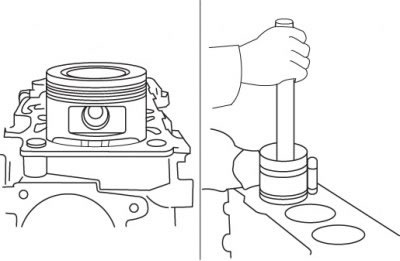
Figure 3.54. Installing the piston into the cylinder: the "F" mark must be directed towards the front of the engine (crankshaft pulley)
Turn the piston with the connecting rod so that the arrow on the piston points towards the front of the engine; carefully insert the piston with the connecting rod into the first cylinder until the mandrel stops against the cylinder block. Lightly tap the top edge of the drift to ensure uniform contact with the cylinder block surface all the way around. If there is no arrow or notch mark on the piston crown, before installing the mandrel, orient the piston so that the "F" mark on the piston pin boss is directed towards the front of the engine (crankshaft pulley) (figure 3.54).
Gently tap the piston crown with the wooden handle of a hammer, guiding the connecting rod onto the corresponding crankshaft journal. Piston rings can pop out of the mandrel before being inserted into the cylinder, so the mandrel must always be pressed against the cylinder block. Perform this operation with care; stop work immediately if you feel any resistance when inserting the piston into the cylinder. Determine the cause of the seizure and eliminate it, then continue installing the piston into the cylinder. Do not force the piston into the cylinder as this may damage the rings or the piston.
After installing the pistons in the cylinder, you need to measure the clearance (between the connecting rod bearings and the shaft journals) and only after that finally install the covers.
Prepare a piece of calibrated plastic rod, the length of which is slightly less than the width of the connecting rod bearing, and place it on the connecting rod journal of the first cylinder parallel to the axis of the crankshaft. The rod must not block the lubrication hole in the shaft journal.
Clean the surfaces of the cover adjacent to the liners, remove the hoses from the cover mounting bolts and install the cover. Make sure the marks on the cap and connecting rod are on the same side. Install the nuts and tighten them to the specified torque in three steps. During this operation, the crankshaft must not rotate.
Carefully remove the caps without damaging the plastic stem. Compare the thickness of the deformed plastic rod with the scale on the packaging and determine the size of the lubrication gap. Compare with the required value. If the clearance is not as specified, recheck to ensure the correct size connecting rod bearings are installed. Also check the bore diameter of the connecting rod and ensure that there is no dirt or oil between the bearings and the seating surfaces when measuring the clearance.
Carefully remove any remaining deformed rod from the crankshaft journals and/or connecting rod bearing surfaces. Avoid damaging the surfaces of the connecting rod bearings; remove any residue with your index finger or a wooden spatula. Make sure the connecting rod bearing surfaces are absolutely clean, apply a thin, uniform coat of high-quality molybdenum disulfide grease or engine assembly oil to the bearing shells. To access the surface of the upper connecting rod bearing, you will have to push the piston into the cylinder, having first placed sections of hose onto the cover bolts.
Pull the connecting rod to the crankshaft journal, remove the hoses from the cap bolts, install the caps and tighten the nuts to the specified torque. Tighten the nuts in three steps.
Repeat the described procedure for the pistons and connecting rods of the remaining cylinders. During assembly, ensure that the mating surfaces of the connecting rod and connecting rod bearings are clean. Make sure that each piston is matched to its cylinder and that the notch, arrow, or "F" mark points toward the front of the engine when installing the piston into the cylinder. Remember that the cylinder must be generously lubricated before installing the ring compressor.
During final assembly of the connecting rods with caps, the working surfaces of the bearings must also be lubricated.
After correctly installing the pistons with connecting rods, turn the crankshaft by hand a few revolutions; the shaft should rotate without jamming.
At the final stage of assembly, it is necessary to check the axial play of the connecting rod.